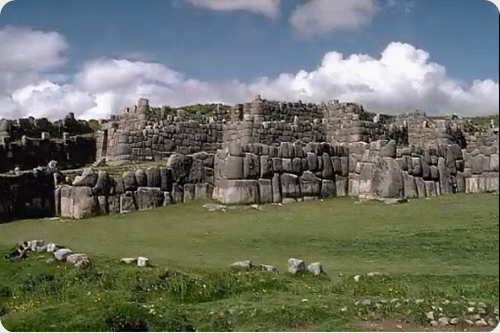
The fortress of Sacsayhuaman Inca testimony of the power and place of worship of the sun god.

Sacsahuaman
Sacsahuaman_wall1
Sacsahuaman_wall3
Sacsayhuaman-c02
Sacsayhuman-map
sacsayhuaman5
sacsayhuaman-cusco-peru-south-america
saSacsayhuaman 2
Sacsayhuaman
Sacsayhuamán_Décembre_2006_-_Vue_Panoramique 
 

Sacsayhuamán_wall_2011Sacsayhuamán (also known as Saksaq Waman, Sacsahuaman or Saxahuaman) is a walled complex on the northern outskirts of the city of Cusco, Peru, the former capital of the Inca Empire. 

The complex is as many other Inca constructions made of large polished dry stone walls, each boulder carefully cut to fit together tightly without mortar.

The site, at an altitude of 3,701 m, was added as part of the city of Cusco to the UNESCO World Heritage List in 1983.
Located on a steep hill that overlooks the city, it contains an impressive view of the valley to the southeast. Surface collections of pottery at Sacsayhuaman indicate that the earliest occupation of the hill top dates back at least a millennium.

SacsayhuamanBecause of its location high above Cuzco and its immense terrace walls, this area of Sacsayhuaman is frequently referred to as a fortress.

The importance of its military functions was highlighted in 1556 when Manco Inca lay siege to Cuzco.

Much of the fighting occurred in and around Sacsayhuaman as it was critical for maintaining control over the city.

It is clear from descriptions of the siege, as well as from excavations at the site, that there were towers on its summit as well as a series of other buildings.
 
If you liked this article, subscribe to the feed by clicking the image below to keep informed about new contents of the blog:

Mortality of dolphins in the seas of Peru disoriented by the sonar ship.

delfino
delfini1
delfini2
delfini3
delfini4
delfini5
delfini6
delfini7
delfini8
delfini9


delfino The boats using these tools in deep waters for the search of oil. The bursts of sound waves produced confusing mammals because they damage the bones of their auditory system.

And 'alarm in Peru for a mortality of dolphins, according to environmental groups, is due to the use of sonar systems in deep water in the shipping industry.

In recent weeks, 615 dolphins were stranded along a coastline of 135 kilometers and early summer in all, some 3,000 units were found dead early summer.

peru-map
Researchers at the Organization for the Conservation of aquatic animals (Orca) explained that ships use sonar in deep waters disorient dolphins because they damage the hearing bones of mammals. The sonar signals, which create real bursts of sound waves, are used for the search of oil.

Orca is estimated that this year is that recorded the highest number of stranded dolphins around the world in the last decade.

With the name of dolphins are commonly indicates a paraphyletic group of marine mammals belonging to the order of Odontoceti and includes the families Delphinidae (oceanic dolphins) and Platanistidae (river dolphins), whose members are generally small.

With its 370 million hectares of the Brazilian Amazon is the largest expanse of primary forest in the world, a third of the total forests around the planet.
 
If you liked this article, subscribe to the feed by clicking the image below to keep informed about new contents of the blog:

The amazing caves Acsibi in the heart of the Valleys Calchaquíes.

acsibi_cuevas1
acsibi_cuevas10
acsibi_cuevas11
acsibi_cuevas2
acsibi_cuevas3
acsibi_cuevas4
acsibi_cuevas5
acsibi_cuevas6
acsibi_cuevas7
acsibi_cuevas8
acsibi_cuevas9

 
acsibi_cuevas2 The Valleys Calchaquies full of mysteries, history, culture, surprise us, dazzle us, transport us to our indigenous past, geography, landscapes, people amaze us every trip. These valleys occupy three provinces: Salta, Tucuman and Catamarca, all located in the northern region.
The sector comprises Salta River valley Calchaquí to its confluence with the Rio Santa Maria, both flow into the Río de las Conchas, located in the Quebrada de Cafayate same name near. 

The amazing shapes that has its ground and walls are the result of centuries of geological movements modified by erosion. 

Today I present in this area Acsibi Cuevas circuit: Also called Valle de las Cuevas, Acsibi is the place where stood the tribe Malcachiscos, about 15 kilometers from the hosting of the House, may be entered in 4x4 vehicles and then proceed with a 4 hour walk in a place drawn by unique geomorphology, with a variety of colors and shapes. 

acsibi_cuevas mapa To reach the caves, go to bed, usually dry river Montenieva located about 3 kms from Seclantás, hit it head on and move forward with 4x4 vehicles for one hour to reach a large stone walls. Here you get off and walk a bit to overcome this barrier and into a valley that combines red sandstone walls of rock and a rich tone, a view very similar to what one imagines the planet Mars. 

Then the canyon narrows, the grass and the thistles are gone, and you need to go through narrow tunnels, crouching, to run into amazing caves with the most rare and unique. 

Here, as the light filters through gaps minimum and where people wonder if it really was who formed the sea that geography is the work of beings from another planet, listen to stories of the Indians who killed Malcachiscos in colonial times Juan Ortiz de Urbina, master of the land. On your next trip to northern Argentina, be sure to visit this area is really indescribable.


If you liked this article, subscribe to the feed by clicking the image below to keep informed about new contents of the blog:

Svalbard is an archipelago in the Arctic Ocean, breeding ground goose white-faced.

oca_della_faccia_bianca
svalbard3
svalbard4
Svalbard_Norway_740
svalbard_Longyearbyen
svalbard-map-4
Svalbard_2_740x225
svalbard5
svalbard_northernlighst_740
svalbard_costa
svalbard_biologiskmangfold
svalbard1 
 

svalbard Svalbard is an archipelago in the Arctic Ocean, halfway between Norway and the North Pole.; Positioned between 74 ° and 81 ° N, and between 10 ° and 34 ° East, is the northernmost part of Norway .

The islands cover an area of ​​62,050 km ². The larger islands Spitsbergen (39,000 km ²), Nordaustlandet (14,600 km ²) and Edgeøya (5000 km ²).

The population is more than 2500 inhabitants. Svalbard is administered by a governor appointed, the sysselmann, whose office is located in the town of Longyearbyen.
Svalbard_map Because of a particular legal situation, all countries that signed the Treaty of Svalbard have the right, like Norway, Svalbard to colonize and to develop the economy, but the only country to take seriously this possibility has been the Soviet Union, whose settlements of Barentsburg and Pyramiden have reached several thousand inhabitants, for a time the most widely spoken language on Svalbard was Russian.

Following the dissolution of the Soviet Union and the interruption of subsidies, the population of Russia (and Ukraine) has been reduced to about 500 units, and Pyramiden was completely abandoned, and from 2009 to Pyramiden some Russians from Barentsburg are trying to resume for tourism in the archipelago.

Again because of certain clauses in the Treaty of Svalbard, there is no particular requirement (such as residence permits, work, etc.) for permanent residence: supposed to be able to find work, there are no obstacles of any kind because the Treaty provides for no discrimination among citizens of the States Parties to the Treaty.

There are no roads between the settlements on the islands; transportation are conducted with boats, planes and helicopters, as well as snowmobiling.
 
If you liked this article, subscribe to the feed by clicking the image below to keep informed about new contents of the blog:

Recent Posts

Antipixels & Counters

Add to Technorati Favorites Peru Blogs BlogESfera Directorio de Blogs Hispanos - Agrega tu Blog

blogspot hit counter

Facebook Twitter RSS